Aug 20, 2012

Joy At Work?

Joy_framed.jpg
For those who want to be speechless and inspired by work, the place to start is charting a course to create joy at work.

Why joy? Joy is an outcome of doing something that makes you happy. Joy is contagious. It has a force of energy that moves people forward with optimism.


Three things to help with the journey:

Increase freedom
The power or right to act, speak, or think as one wants without hindrance or restraint” 

Create purpose
For joy to emerge at work, the team must revisit why it exists and reclaim a shared purpose. It’s a purpose that calls you forward to accomplish something bigger than any one person. 

Align strengths and work
Learn what each person’s strengths are and then shift work around them.

None of the three items above can be thought about alone. They must escape your brain and be shared with your team. To create joy requires a community of committed people: committed to each other, their own growth and a common calling that dares them to be bold in their work.

Joy at work is possible, but you’ll need to shed conventional beliefs about how work is done and the relationship between managers and employees. The very exploration of both can generate joy at work. But you must take the first step and recognize that how things are today is simply not working.

Aug 18, 2012

Happy Weekend - Here is a kool summer utensil :o)

The Watermelon Knife is purpose-built by Kuhn-Rikon of Switzerland to enable even the sloppiest kitchen novice to slice watermelons like a pro. The fact the knife looks like a watermelon itself only adds to the joy of using it.

Source

Fear & Hope


"We should not let our fears hold us back from pursuing our hopes."


- John F. Kennedy

Aug 17, 2012

Take a Hike

Employee_Engagement_Dashboard.jpgAccording to research by AbsoluteGlobal.net, the top 10 reasons employees leave their jobs are all related to the inability of managers to provide a work environment that meets their employees’ needs. To retain talent, managers must find ways to provide a workplace culture that promotes productivity while keeping employees challenged, stimulated and fulfilled. Here are a few strategies to help you do that:
  • Make work challenging. People tend to enjoy their work more when there is some sort of challenge involved. Solving problems invigorates people and makes them feel good about what they do.
  • Empower your employees. Employees who have some say in how they do their jobs tend to be happier and more fulfilled. Empower empoyees by giving them the latitude to make decisions related to their jobs, even if that means allowing them to make mistakes now and then.
  • Don’t overwork your employees. One of the biggest reasons employees leave is because they are expected to do more work than they can handle. If you lay off several employees and distribute their work to those who are left behind, you are going to end up with overworked and stressed out employees who can’t wait to leave. Keep employees’ workloads fair.
  • Ask them what they want. You don’t have to wait until someone quits to find out what needs are not being met. Ask questions to determine potential problem areas and take steps to eliminate them.
  • Show appreciation. A common complaint among employees is the lack of appreciation. Too many times, employees are expected to give everything they have without getting anything for their efforts but a paycheck. People love to hear that they’ve done a good job. Give praise freely when it is merited; it costs nothing and does far more to keep employees happy and motivated than most tangible benefits.
Source

Aug 16, 2012

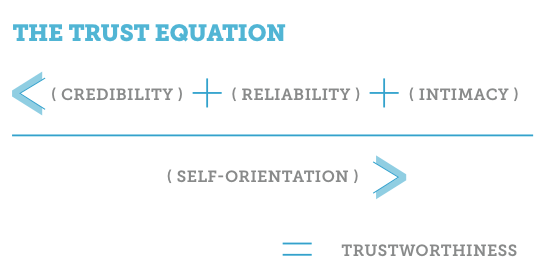
The Trust Equation


The Trust Equation
When we think of trust and what it means, we quickly realize it encompasses many things. We use the word “trust” to:
  • Interpret what people say
  • Describe behaviors
  • Decide if we feel comfortable sharing information
  • Indicate whether we feel other people have our interests at heart
The Four Variables
The Trust Equation uses four objective variables to measure trustworthiness. These four variables are best described as: Credibility, Reliability, Intimacy and Self-Orientation.
We combine these variables into the following equation:
TQ stands for Trust Quotient. The Trust Quotient is a number — like your IQ or EQ — that benchmarks your trustworthiness against the four variables.
Let’s dig into each variable a bit more:
  1. Credibility has to do with the words we speak. In a sentence we might say, “I can trust what she says about intellectual property; she’s very credible on the subject.”
  2. Reliability has to do with actions. We might say, “If he says he’ll deliver the product tomorrow, I trust him, because he’s dependable.”
  3. Intimacy refers to the safety or security that we feel when entrusting someone with something. We might say, “I can trust her with that information; she’s never violated my confidentiality before, and she would never embarrass me.”
  4. Self-orientation refers to the person’s focus. In particular, whether the person’s focus is primarily on him or herself, or on the other person. We might say, “I can’t trust him on this deal — I don’t think he cares enough about me, he’s focused on what he gets out of it.” Or more commonly, “I don’t trust him — I think he’s too concerned about how he’s appearing, so he’s not really paying attention.”
The Trust Equation has one variable in the denominator and three in the numerator.
Increasing the value of the factors in the numerator increases the value of trust. Increasing the value of the denominator — self-orientation — decreases the value of trust.
Self-orientation, which sits alone in the denominator, is the most important variable in the Trust Equation. We developed the formula this way on purpose. 
It’s All About People
The Trust Equation covers the most common meanings of trust that you encounter in everyday business interactions. What’s important to remember is that the meanings are almost entirely personal, not institutional.
People rarely give over their trust to institutions; really they trust other people.
While companies are often described as credible and reliable (the first two components of The Trust Equation), it’s really the people within the companies that make those companies what they are. And intimacy and self-orientation are almost entirely about people.
Trust in business requires good “scores” on all four variables in the Trust Equation. You want high credibility, reliability and intimacy, and low self-orientation.
Living the four Trust Values is the best way to increase your trustworthiness. The Trust Equation provides a scientific, analytical and actionable framework for how we help organizations and individuals improve their businesses and lives.

Aug 15, 2012

Flat Ruthie, Behind The Scenes...


It has come to my attention that I may have been remiss in explaining what Flat Ruthie is all about.

My friend Mark's (formally Detroit, now Omaha) daughter is a host for Flat Ruthie, who travels the world visiting fellow bloggers and friends.  After his daughter visited him this summer, he kept Flat Ruthie and offered her up for adventures for any of his followers.  With our pending trip to Florida, we offered to host Flat Ruthie on a "Road Trip". So that, my friends, is the story behind our friend Flat Ruthie.  She will soon be on her way via USPS to Omaha Mark :o)

Go to the blog to see Flat Ruthie's adventures!

Confidence

confidence.jpg
If your confidence is low, rather than extremely low, you stand a better chance of succeeding than if you have high self-confidence. There are three main reasons for this:
Lower self-confidence makes you pay attention to negative feedback and be self-critical: Most people get trapped in their optimistic biases, so they tend to listen to positive feedback and ignore negative feedback. 

To be the very best at anything, you will need to be your harshest critic, and that is almost impossible when your starting point is high self-confidence.

Lower self-confidence can motivate you to work harder and prepare more: If you are serious about your goals, you will have more incentive to work hard when you lack confidence in your abilities. In fact, low confidence is only demotivating when you are not serious about your goals.

Lower self-confidence reduces the chances of coming across as arrogant or being deluded. Although we live in a world that worships those who worship themselves — from Donald Trump to Lady Gaga to the latest reality TV "star" — the consequences of hubris are now beyond debate. According to Gallup, over 60% of employees either dislike or hate their jobs, and the most common reason is that they have narcissistic bosses.

Lower self-confidence reduces not only the chances of coming across as arrogant, but also of being deluded. Indeed, people with low self-confidence are more likely to admit their mistakes — instead of blaming others — and rarely take credit for others' accomplishments. This is arguably the most important benefit of low self-confidence because it points to the fact that low self-confidence can bring success, not just to individuals but also to organizations and society.

In brief, if you are serious about your goals, low self-confidence can be your biggest ally to accomplish them. It will motivate you to work hard, help you work on your limitations, and stop you from being a jerk, deluded, or both. It is therefore time debunk the myth: High self-confidence isn't a blessing, and low self-confidence is not a curse — in fact, it is the other way around.

Aug 14, 2012

Accomplishment


symbol.jpg
"To be yourself in a world that is constantly trying to make you something else is the greatest accomplishment."
- Ralph Waldo Emerson