Showing posts with label recycle. Show all posts

May 19, 2012

Fashion Police Not Needed

A bin for recycling clothing, flanked by two like-minded companions.

Approximately a year after introducing a textile recycling program in New York City, supporters have pronounced it a grand success.
Last May, the city formed a partnership with Housing Works, a group that helps homeless people who are H.I.V.-positive, to pick up donated clothing at apartment buildings in one of the first large-scale consumer textile recycling programs in the country. The goal is to capture most of the 200,000 tons of apparel  and other textiles that New Yorkers throw away each year but that could be reused instead and there-by reduce the city’s garbage disposal costs.
At a City Council hearing on Friday, Department of Sanitation officials reported that over 50 tons of textiles were donated in the first six months of the program. That amount is expected to rise to more than 300 tons for the second half of the first year.
While about 130 buildings are now taking part, the Department of Sanitation is still processing requests and more than 1,000 inquiries. Donations are tax-deductible, and the program, called Re-fashioNYC, is paying for itself through sales of donated items.

Almost every clothing item, including shoes and accessories like handbags and belts, can be recycled. The Secondary Materials and Recycled Textiles Association, a trade group, emphasizes that materials like stained or ripped clothing, buttons and zippers can be processed and reborn as wiping cloths, carpet padding and other products.

Jan 13, 2012

Recycle Machine!


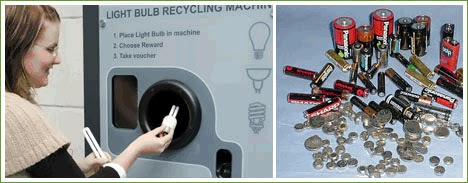
We all know that batteries and CFL light bulbs don't belong in the trash, but recycling locations are not always convenient.  What if your local retail stores just had a vending machine where you could drop these items?  Well, that convenient option could be coming to us soon.


A company called reVend Recycling Ltd. has begun installing recycling vending machines for light bulbs and batteries in the U.K. that not only sort the items, but offer immediate rewards.


The first pilot machine was installed at an IKEA in London with great success.  At that location, recyclers were offered store credit to IKEA based on the amount they were recycling or the choice to donate to one of four charities -- the World Wildlife Fund, Woodland Trust, UNICEF and Save the Children.


The machines accept incandescents, CFLs and LEDs as well as any domestic batteries.  The machines are able to track the bulbs and batteries by type, manufacturer and volume so that each can end up in the appropriate recycling facilities.


The company has signed an agreement with IKEA to install their machines throughout the U.K., Germany and Denmark.  They plan to expand their reach to more parts of Europe as well as into the U.S. very soon.

Sep 20, 2011

Recyclable?


Starbucks sells on average 8.2 million paper cups of coffee a day, all of which can be recycled, but most still end up in landfills.
The world’s biggest coffee chain wants to change that by convincing everyone from recycling companies to paper mills that it’s worth the effort to recycle paper cups. But the strategy has proved a hard sell, calling attention to a widespread problem in the recycling movement: Just because something is recyclable doesn’t mean it gets recycled.
About 25 percent of items thrown into home recycling bins are never recycled, said Susan Collins, executive director of the nonprofit group Container Recycling Institute. Oftentimes items are deemed unusable by the time they reach recycling centers because they are contaminated with food or laced with broken glass from containers that shattered in the same bin.
Currently, recycling companies want to focus on other materials, like cardboard and aluminum, for which there is an attractive resale market. That’s not the case with paper cups, forcing Starbucks to try to collect as many of its own cups as it can, strike deals with companies to recycle them, and then agree in some cases to buy back the material.
“You can collect all of this stuff,’’ said Christine Beling of the Environmental Protection Agency, who agrees with Starbucks’ approach. “But unless you have someone to buy it from you, who cares?’’
With paper cups for coffee, there is another major issue: Many recycling companies don’t have the equipment to separate the cup’s paper from its inner lining which prevents hot liquids from leaking.
To improve collections, Starbucks has been installing special bins designed to segregate coffee cups from other waste; the chain recently introduced them in all 30 of the company’s stores in the Boston area. The chain is then lining up companies that have agreed to recycle its cups, which have been made of 10 percent post-consumer recycled fiber since 2006. In Massachusetts, Starbucks is working with RockTenn, with plants scattered across the United States, to collect the cups, recycle them, and sell the material to paper mills.
In some markets, such as New York and Chicago, the company is working with paper mills and recycling centers to turn some of the recycled paper cups into napkins used by Starbucks.
“The focus is often, ‘What can I do to the cup to make it more recyclable?’ ’’ said Jim Hanna, Starbucks’ director of environmental impact. “What’s more important is, ‘What can I do to the infrastructure to make these cups more recyclable?’ ’’

Jan 19, 2009

Science Scene: Solar - is there a toxic downside?

Everybody loves solar, the shiny superstar of renewable energy.

But scratch the surface of the manufacturing process and the green sheen disappears. Vast amounts of fossil fuels are used to produce and transport panels. Solar cells contain toxic materials. Some components can't be easily recycled.

That has some environmentalists worried about a new tidal wave of hazardous waste headed for the nation's landfills when panels eventually wear out. You can't just call your product green and close your eyes to what's happening in the supply chain. The solar energy industry is running into some of the same problems that have been seen in the electronics industry, whose waste is polluting U.S. landfills and contaminating groundwater with harmful substances such as mercury and chromium.

Solar energy supplies less than 1% of the nation's electricity at present. But the technology is poised for explosive growth. Much of the world's production is centered in Asia, but there are some disturbing trends emerging there. China is major producer of polycrystalline silicon, a key component of solar cells. The Washington Post last year documented how at least one Chinese producer was dumping a toxic byproduct from that manufacturing process on nearby farmland. Experts suspect that firms in other developing countries are taking similar shortcuts.

Davis said developing benign substitutes for some of the most dangerous materials was essential for the solar industry to be truly sustainable. Making the panels is just the beginning. Planning needs to begin now on what to do with millions of these heavy modules as they wear out in 20 to 25 years or are replaced with better technology, environmentalists say.

The high-tech industry generated more than 2.6 million tons of e-waste in the U.S. in 2005, about 87% of which ends up in landfills or incinerators. Most of the rest was exported to developing countries to be dismantled by low-wage workers, many of whom are exposed to dangerous substances lurking in the guts of personal computers and other electronics.

Solar can not go down that path. State and national governments need to consider legislation to keep cleanup costs from falling to taxpayers. Thinking about recycling of the panels in the future needs to be part of the upfront design and manufacturing process.

Source: 1/14/09, Los Angeles Times, by Marla Dickerson.