Here is a link to the latest information on the nuclear situation in Japan.
Mar 22, 2011


SMART Goals

The SMART acronym is a great tool for making sure our goals and instructions are specific, measurable, attainable, relevant, and timed. It helps us clarify what we want to accomplish and set deadlines to make sure it produces the results we want in the timeframe we need. The six steps below will help you formulate your goals in the most effective way possible.
Step 1: Consider Your Intentions. What is the end result I want to achieve? Why is this important to me and/or the organization?
Step 2: Make it Specific. If someone else read this goal, would they be able to execute it without me having to explain it? Does it provide answers to: Who? What? When? and Where? Is it short and concise?
Step 3: Make it Measurable. "What gets measured gets done." How will I know that this goal or milestone has been accomplished and to what standard? How will I measure it and how frequently will I do so?
Step 4: Make it Attainable. Can this goal (with some stretching) be accomplished in the timeframe I have indicated? If not, break down the goal into smaller pieces and write a goal statement for the first step.
Step 5: Make it Relevant. If goals aren't or don't feel relevant we tend to put them on the backburner. How does this goal align with the bigger picture (personally and professionally)? What "pains" would I experience if I didn't get this goal accomplished?

Step 6: Make it Timed. Most goals fail because we haven't indicated the timeframe in which we want to have them accomplished. Have I established an overall deadline for when this goal must be accomplished? Have I indicated milestones or smaller deadlines for contributing activities? By when do I want this to be accomplished?
Mar 21, 2011
Fukushima Daiichi - Update
Workers were making progress Monday to bring offsite power to the Fukushima Daiichi nuclear plant. External electricity has been connected to reactor 2, and work continued to energize the reactor’s cooling systems. Reactors 5 and 6, and the used fuel pools at those reactors, were switched from backup diesel generators to the offsite power supply. Work also continued to establish electric service to reactors 3 and 4.
Spraying seawater into the spent fuel pools of reactors 3 and 4 and providing additional cooling water to the fuel pool at reactor 2 continue to be a priority for TEPCO’s recovery workers. Water spraying at the Daiichi site’s common used fuel pool began Monday morning, the Nuclear and Industrial Safety Agency said.
Tokyo Electric Power Co. continued efforts on Monday to restore power to its reactors at Fukushima Daiichi as well as stabilize cooling in the used fuel pools of some reactors. Reactors 1, 2 and 3 are in stable condition and reactors 5 and 6 are stable and being cooled by systems powered by electricity that was restored over the weekend.
The Tokyo Fire Department sprayed cooling water into the reactor 3 used fuel pool for about 4.5 hours, ending early Monday morning. At reactor 4, Japan’s Self-Defense Force sprayed water into the pool for about two hours. Overall, 13 fire engines have been used in the spraying. Efforts to spray water into the used fuel pools at reactors 3 and 4 reactor buildings and used fuel pools was stopped on Monday while TEPCO assessed the effectiveness of these efforts.
Electricity is expected to be restored to both reactors 3 and 4 by March 23.
Radiation dose rates at monitoring posts are slightly higher than on past days. Rates at the plant site boundary range from 1 to 3 millirem per hour. Radiation dose rates in the area where fire trucks have been located are reported to be 2 to 3 rem per hour, with some isolated areas as high as 30 rem per hour.
Spraying seawater into the spent fuel pools of reactors 3 and 4 and providing additional cooling water to the fuel pool at reactor 2 continue to be a priority for TEPCO’s recovery workers. Water spraying at the Daiichi site’s common used fuel pool began Monday morning, the Nuclear and Industrial Safety Agency said.
Tokyo Electric Power Co. continued efforts on Monday to restore power to its reactors at Fukushima Daiichi as well as stabilize cooling in the used fuel pools of some reactors. Reactors 1, 2 and 3 are in stable condition and reactors 5 and 6 are stable and being cooled by systems powered by electricity that was restored over the weekend.
The Tokyo Fire Department sprayed cooling water into the reactor 3 used fuel pool for about 4.5 hours, ending early Monday morning. At reactor 4, Japan’s Self-Defense Force sprayed water into the pool for about two hours. Overall, 13 fire engines have been used in the spraying. Efforts to spray water into the used fuel pools at reactors 3 and 4 reactor buildings and used fuel pools was stopped on Monday while TEPCO assessed the effectiveness of these efforts.
Electricity is expected to be restored to both reactors 3 and 4 by March 23.
Radiation dose rates at monitoring posts are slightly higher than on past days. Rates at the plant site boundary range from 1 to 3 millirem per hour. Radiation dose rates in the area where fire trucks have been located are reported to be 2 to 3 rem per hour, with some isolated areas as high as 30 rem per hour.
Mar 20, 2011

Mar 19, 2011
Fukushima Daiichi Update - Good News
UPDATE AS OF 8:00 P.M. EDT, SATURDAY, MARCH 19:
Powered by an emergency diesel generator, pumps are circulating cooling water in the spent fuel pools of reactors 5 and 6 at the Fukushima-Daiichi nuclear power plant, according to reports. The company also added water to the used fuel pool at reactor 3 after elite firefighters from Tokyo spent 13 hours operating a high-pressure spray truck that pumped seawater into the pool.
The company and response workers were planning to spray water into the used fuel pool at reactor 4 on Sunday.
Electric power lines are connected to reactors 1 and 2 and engineers expected to bring power to the remaining reactors on Sunday, according to the Japan Atomic Industrial Forum. “We do not know if the water pumps [at Fukushima Daiichi] have been damaged and if they will work when power is restored,” the International Atomic Energy Agency said.
Tokyo Electric Power Co. reported that holes have been drilled into the ceilings of the buildings that house reactors 5 and 6 to prevent the buildup of hydrogen in the buildings.
Mar 18, 2011
Are you and Engineer or a Manager?
A group of managers are given an assignment to measure the
height of a flagpole. So they go out to the flagpole with
ladders and tape measures, and they're falling off the ladders
and dropping the tape measures. The whole thing is just a mess.
An engineer comes along and sees what they're trying to do,
walks over, pulls the flagpole out of the ground, lays it flat,
measures it from end to end, gives the measurement to one of
the managers and walks away.
After the engineer has gone, one manager turns to another and
laughs: "Isn't that just like an engineer? We're looking for
the height and he gives us the length!"
Mar 16, 2011

14 Easy Ways to Decrease Your Energy Bill

7 Free Ways: No excuses here!
- Keep your thermostat at 68 in winter and 78 in summer.
- Set your hot water heater at 120 degrees: each 10 degree reduction saves you up to 5% on your bill.
- Avoid using the ‘heated dry’ cycle on the dishwasher – just let them air dry
- Conserve water – wash clothes on cold and shorten your shower: this reduces your bill and your impact on a very limited resource.
- Line dry your laundry when the weather is nice.
- Use a ceiling fan in the summer and wear an extra layer in the winter.
- Unplug your electronics when not in use: anything with a LED light glowing (e.g., cell phone charger, computer monitor, etc.) is drawing power even if it is not ‘on.’
- Replace your incandescent light bulbs with compact fluorescent.
- Make sure all your windows and doors are well sealed with caulking or or weatherstripping.
- Make sure your plumbing and wiring penetrations are sealed.
- Get your heating and cooling system serviced annually to maintain and monitor efficiency.
- Insulate your hot water heater
- Insulate your air compressor and hot water piping.
- Change your air filters at least every 3 months.
Mar 14, 2011
Fukushima Daiichi
First, the reactors that are considered in danger are all shut down, the control rods are in the core. The only concern is decay heat, which represents 3% of the operating power, and it is reduced exponentially every day that passes.
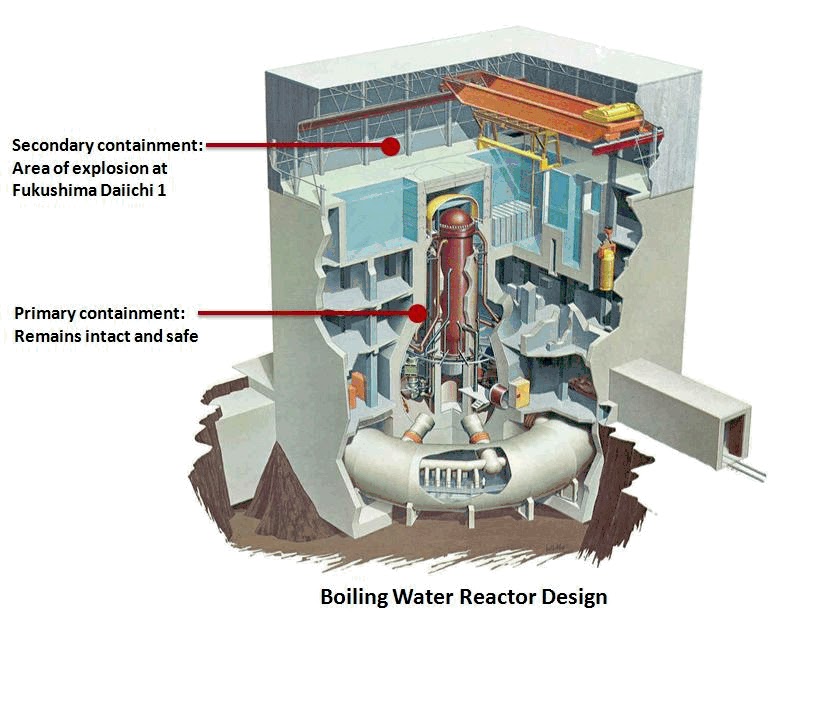
Second, reactors have three levels of primary protection: the fuel cladding (the metal casing that holds the fuel together), the reactor vessel (4-8" thick metal containment vessel), and the primary containment (40-80 inch thick concrete and steel building). So far, only the fuel cladding has been compromised (some cladding "meltdown" experienced), and that is why there is not a significant release of radiation (clad melts at about 2000 degrees, the fuel itself at 4000 degrees). The pumping of seawater into the containment reduces the potential for the higher temperatures to be realized.
The hydrogen explosions have been due to the release of pressurized gases from the reactor vessel and primary containment, as developed through emergency operating procedures, into the secondary containment. The release of the disassociated hydrogen into the atmosphere, through pinch points, results in gaseous explosion, but not damage to the second or third level of containment protection.
Below are news release details:
The hydrogen explosion on March 11 between the primary containment vessel and secondary containment building of the reactor did not damage the primary containment vessel or the reactor core. To control the pressure of the reactor core, Tokyo Electric Power Co. began to inject seawater and boric acid into the primary containment vessels of Unit 1 on March 12 and Unit 3 on March 13. There is likely some damage to the fuel rods contained in Units 1 and 3.
At both Units 1 and 3, seawater and boric acid is being injected into the reactor using fire pumps. On Unit 3, a pressure relief valve in the containment structure failed to open, but was restored by connecting an air pressure to the line driving valve operation.
The water level in the reactor vessel of Unit 2 is steady (update, seawater injection also required for Unit 2).
Personnel from TEPCO are closely monitoring the status of all three reactors.
The highest recorded radiation level at the Fukushima Daiichi site was 155.7 millirem at 1:52 p.m. EDT on March 13. Radiation levels were reduced to 4.4 millirem by the evening of March 13. The Nuclear Regulatory Commission’s radiation dose limit for the public is 100 millirem per year.
Japanese government officials acknowledged the potential for partial fuel meltdowns at Fukushima Daiichi Units 1 and 3 reactors, but there is no danger for core explosion, as occurred at the nuclear power station at Chernobyl in 1986. Control rods have been successfully inserted at all of the reactors, thereby ending the chain reaction. The reactor cores at Fukushima Daiichi and Daini power stations are surrounded by steel and concrete containment vessels of 40 to 80 inches thick that are designed to contain radioactive materials.
Science Scene - EV Charging in Windy City

The charging stations will be located at shopping malls, both of the city's airports, rest stops along the Illinois Tollway and other various locations, and two will even be solar powered.

Source
Subscribe to:
Posts (Atom)