Showing posts with label Fukushima Daiichi. Show all posts

Dec 3, 2011

Fukishima Update

Early on Wednesday morning, the Dow Jones News Wire first reported the following from Japan, before the rest of the mainstream media got hold of the story:
The melted nuclear fuel within the No. 1 unit at the Fukushima Daiichi power plant was of such intensity that it eroded through 2 meters of the 2.6 meter (8.5 feet) concrete base, plant operator Tokyo Electric Power Co. said in a report issued on Wednesday. 
What's been reported is a very conservative mathematical analysis that has yet to be physically confirmed. In other words, this is a worst case scenario. And as we've seen in our industry, even in the worst case scenario, there is still a very significant safety margin.

A quick read ofthe article could give one the impression that the melted core was a little more than half a meter -- about 2 feet -- from reaching the external environment. I think it’s important to note that according to the TEPCO analysis only .7 meters (a little more than two feet) of concrete was actually eroded.  In addition, plants have multiple redundant safety systems in place to protect the public, and that's exactly the case with Fukushima Daiichi Unit 1.

In addition to the 2.6 meters (about 8.5 feet) of steel reinforced concrete inside the containment vessel, underneath the steel shell of the containment vessel lies another 7.6 meters (about 25 feet) of basemat reinforced concrete and steel. Altogether, that means there was 10.2 meters (about 33.5 feet) of reinforced concrete and steel standing between the reactor core and the outside of the plant before the accident.

Even if 2 meters (about 6.5 feet) of that structure has been eroded, another 8.2 meters (almost 27 feet) of reinforced steel and concrete lies between the melted fuel and the external environment.

It’s also important to note that according to tests of air samples from inside containment, it appears that the process of erosion – called coriuminteraction – has essentially ceased and no further damage is occurring at this time. If that process is still continuing, it is doing so at such a slow rate that TEPCO has more than enough time to develop a mitigation strategy.

Apr 3, 2011

US Nuclear Power - How Safe Is It?

The following guest editorial will be featured in this coming Sunday’s local newspaper. The editorial provides answers to some common questions concerning on US Nuclear plant's ability to safeguard the health and safety of the public — or maybe even your friends and family — in the face of a natural disaster or terrorist threat.

As the world continues to watch the tragic circumstances in Japan, we at our Nuclear Plant understand that you may have new questions about living near a nuclear power plant. We have always tried to be open and available to the community, however, we understand the situation in Japan likely calls for increased dialogue.

All U.S. nuclear plants are designed to handle extreme environmental hazards including tornados, earthquakes or floods. Our plant is located more than 400 miles from the nearest fault line and is engineered to withstand an earthquake of up to 6.4 on the Richter scale. This translates into an even larger earthquake as measured at the epicenter.  

Since our plant is located on a lake, a tsunami is not possible.  However, we do have procedures for flooding or a seiche – which is a large wave on an enclosed body of water.  Seiches, however, are rare occurrences.  The largest seiche on record near our plant was 8 feet in 1954.  Our plant is designed to perform properly if there is an 11-foot seiche or flood.

A tornado is the most likely natural disaster here in the Midwest. The plant is designed to safely shut down despite the effects of an F5 tornado with 300 mph winds. Still, we acknowledge that not all natural disasters are predictable.  Please rest assured our personnel plan and prepare for severe conditions that may be greater than our design basis.

We all know that the lack of power following the tsunami was a problem in Japan. Our transmission switchyards are a hub of electrical distribution for our region and we have seven separate high-voltage connections to the grid. Each of our two reactors has two locomotive sized back-up diesel generators that
start automatically if offsite power is lost. Only one is required to safely shut down each reactor. These are located in seismically secure rooms 9 feet above lake level. There is also a supplemental diesel generator, something the Japanese plants didn’t have, that could safely shut down either unit.  This is located 23 feet above lake level.

We are participating in a U.S. nuclear industry initiative to verify our capability to protect the public under severe adverse conditions. The Nuclear Regulatory Commission (NRC) is also performing an independent review of our capabilities and has established a task force to develop safety improvement initiatives based on the Japanese events.

Our emergency response plans are very detailed and we regularly train and practice with the County and State emergency management groups. We recently participated with the NRC and Federal Emergency Management Agency (FEMA) evaluation of our emergency preparedness exercise and determined we successfully demonstrated our ability to protect the public in the event of an emergency at the plant.

If you have additional questions, please call or email (details omitted). We also have speakers available to talk to your service club, school or church group.

We will use the lessons learned from Japan’s tragic event to ensure that we continue to operate to the highest standards. Your health, safety and security are, and always will be our number one focus. More than 1,100 men and women at our plant  – your neighbors – are standing with me on that promise.

Mar 19, 2011

Fukushima Daiichi Update - Good News


UPDATE AS OF 8:00 P.M. EDT, SATURDAY, MARCH 19:


Powered by an emergency diesel generator, pumps are circulating cooling water in the spent fuel pools of reactors 5 and 6 at the Fukushima-Daiichi nuclear power plant, according to reports. The company also added water to the used fuel pool at reactor 3 after elite firefighters from Tokyo spent 13 hours operating a high-pressure spray truck that pumped seawater into the pool.

The company and response workers were planning to spray water into the used fuel pool at reactor 4 on Sunday.
Electric power lines are connected to reactors 1 and 2 and engineers expected to bring power to the remaining reactors on Sunday, according to the Japan Atomic Industrial Forum. “We do not know if the water pumps [at Fukushima Daiichi] have been damaged and if they will work when power is restored,” the International Atomic Energy Agency said.

Tokyo Electric Power Co. reported that holes have been drilled into the ceilings of the buildings that house reactors 5 and 6 to prevent the buildup of hydrogen in the buildings.

Mar 14, 2011

Fukushima Daiichi

I will try and keep this simple, but the bottom line is that the danger you are hearing on the constant news is overblown.


First, the reactors that are considered in danger are all shut down, the control rods are in the core.  The only concern is decay heat, which represents 3% of the operating power, and it is reduced exponentially every day that passes.


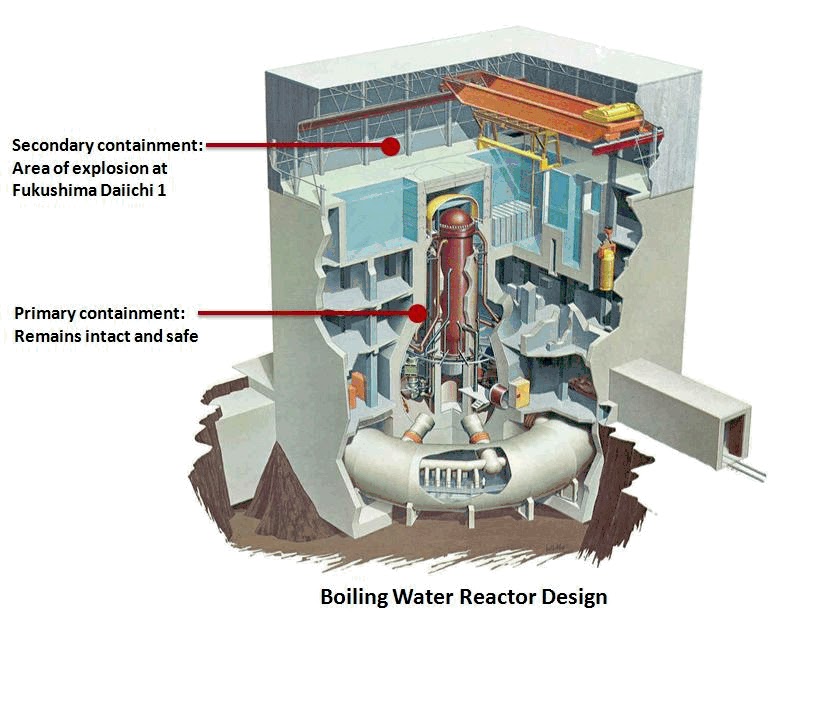
Second, reactors have three levels of primary protection:  the fuel cladding (the metal casing that holds the fuel together), the reactor vessel (4-8" thick metal containment vessel), and the primary containment (40-80 inch thick concrete and steel building).  So far, only the fuel cladding has been compromised (some cladding "meltdown" experienced), and that is why there is not a significant release of radiation (clad melts at about 2000 degrees, the fuel itself at 4000 degrees).  The pumping of seawater into the containment reduces the potential for the higher temperatures to be realized.


The hydrogen explosions have been due to the release of pressurized gases from the reactor vessel and primary containment, as developed through emergency operating procedures, into the secondary containment.  The release of the disassociated hydrogen into the atmosphere, through pinch points, results in gaseous explosion, but not damage to the second or third level of containment protection.


Below are news release details:


The hydrogen explosion on March 11 between the primary containment vessel and secondary containment building of the reactor did not damage the primary containment vessel or the reactor core.  To control the pressure of the reactor core, Tokyo Electric Power Co. began to inject seawater and boric acid into the primary containment vessels of Unit 1 on March 12 and Unit 3 on March 13.  There is likely some damage to the fuel rods contained in Units 1 and 3. 

At both Units 1 and 3, seawater and boric acid is being injected into the reactor using fire pumps. On Unit 3, a pressure relief valve in the containment structure failed to open, but was restored by connecting an air pressure to the line driving valve operation.

The water level in the reactor vessel of Unit 2 is steady (update, seawater injection also required for Unit 2).

Personnel from TEPCO are closely monitoring the status of all three reactors.

The highest recorded radiation level at the Fukushima Daiichi site was 155.7 millirem at 1:52 p.m. EDT on March 13. Radiation levels were reduced to 4.4 millirem by the evening of March 13.
The Nuclear Regulatory Commission’s radiation dose limit for the public is 100 millirem per year. 

Japanese government officials acknowledged the potential for partial fuel meltdowns at Fukushima Daiichi Units 1 and 3 reactors, but there is no danger for core explosion, as occurred at the nuclear power station at Chernobyl in 1986. Control rods have been successfully inserted at all of the reactors, thereby ending the chain reaction. The reactor cores at Fukushima Daiichi and Daini power stations
are surrounded by steel and concrete containment vessels of 40 to 80 inches thick that are designed to contain radioactive materials.